
Spirituality.
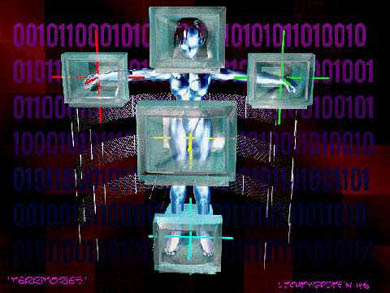
Sven Birkits distrusts the oncoming power of simulated authority,as it has little grounding in what he considers our natural roots. Wen Stephenson describes Birkits's Gutenberg Elegies:
Woven into this expanding web--pervading our academicinstitutions and trickling down into the mass media by way ofhigh-brow journalism, film, and now, he fears, the Internet--is anihilistic "postmodern culture" with its "vast fabric of competingisms," chief among them a terrorizing "absolute relativism" (228).
Yet how do these "isms" differ from, say, Catholocism? Orspiritualism in general?
. . . What becomes of the divinity when it revealsitself in icons, when it is multiplied in simulacra? Does it remainthe supreme power that is simply incarnated in images as a visibletheology? Or does it volatize itself in the simulacra that, alone,deploy their power and pomp of fascination -- the visible machinery oficons substituted for the pure and intelligible idea of God?(4)
Although we can integrate symbols andicons into our tangible lives, we remind ourselves that these merelyhint at the true, infinite nature of our selected deity/deities. Signs like the cross or the swastika or the schwa spread easily andstick in one's head, yet they hold no substance in and of themselves; they each represent a larger concept that one cannot grasp fully. This sound a lot like the world wide web; the WWW is a world toolarge to comprehend in its entirety, so we must construct manageable,symbolic interfaces for effective navigation through a sea ofinformation. Steven Johnson goes on in his book Interface Cultureabout the nature of these interfaces:
When I think about the gap between raw information andits numinous life on the screen -- something I try to avoid doing,because it is a dark and difficult thought, more than a little likecontemplating the age of the universe -- the whole sensation has astrangely religious feel to it, that sense of the mind trying to reacharound a vibrant (and convenient) metaphor to the wider truth thatlies beyond. Cathedrals, remember, were "infinity imagined," theheavens brought down to earthly scale. The medieval mind couldn't takein the full infinity of godliness, but it could subjugate itselfbefore the majestic spires of Chartres or Saint-Sulpice. The interfaceoffers a comparable sidelong view onto the infosphere, half unveilingand half disappearing act. It makes information sensible to you bykeeping most of it from view -- for the simple reason that "most ofit" is far too multitudinous to imagine in a singlethought.
 Others have also suggested that the digital world is taking usfull circle back to a spiritual realm where gods are more real thanpeople. Timothy Leary, in his book Chaos and Cyberculture,describes this succinctly:
A Definition of "Spiritual" Could Be "Digital."
Recite to yourself some of the traditional attributes of the word"spiritual": mythic, magical, ethereal, incorporeal, intangible,nonmaterial, disembodied, ideal, platonic. Is that not a definition ofthe electronic-digital?
The quantum-electronic universe of information defines the newspiritual state. These "spiritual" realms, over centuries imagined,may, perhaps, now be realized! The more philosophic among us find thisphilosophically intoxicating.
Granting digital technology the power of deity also allows attribution of evil. Some fear that within our emerging cyberculture lurks The Devil.


